
In the final part of this feature, I look at PC's and handheld's
To read previous parts:
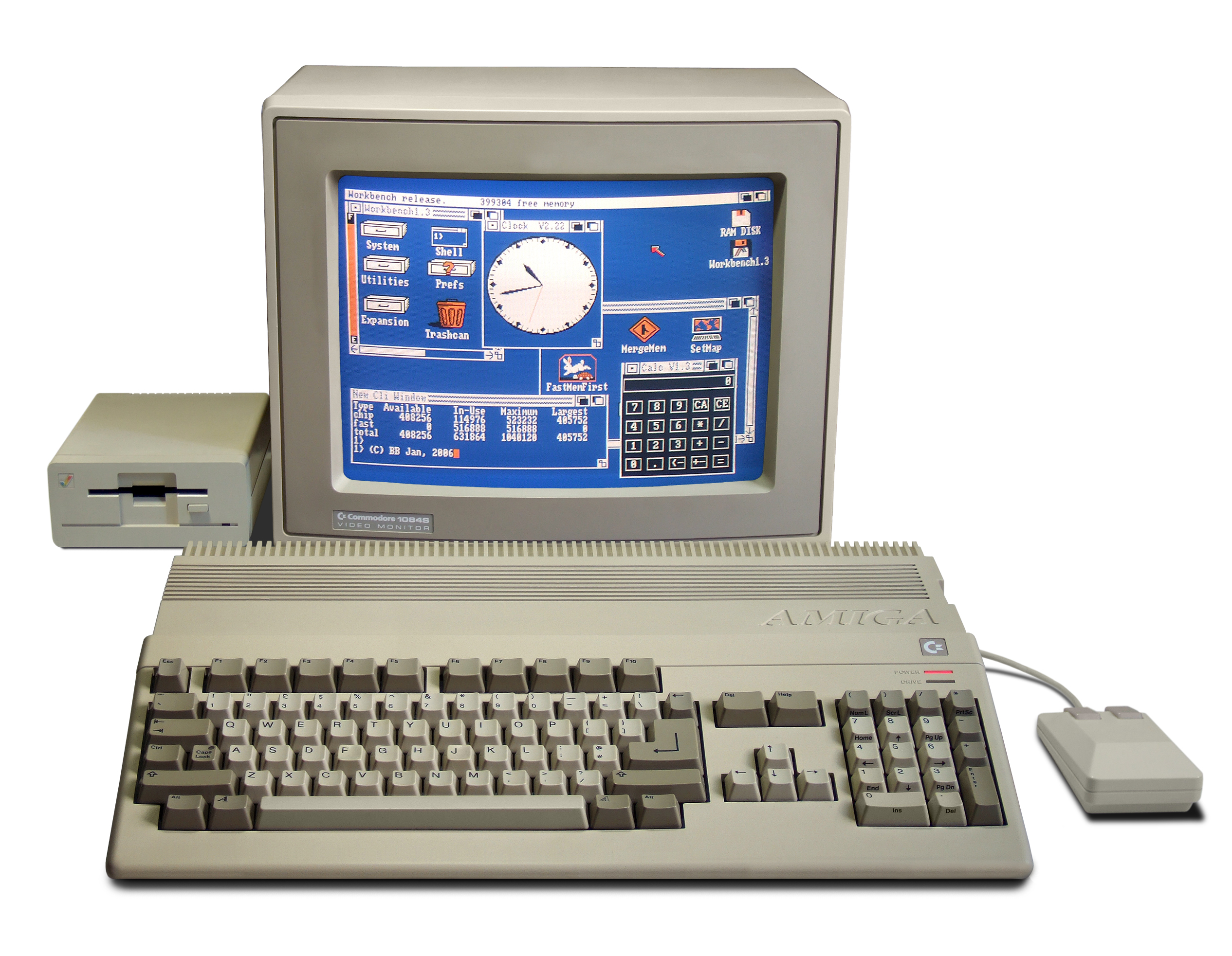 My PC history is far more interesting than my handheld one, I know that much. The first thing I owned which could be called a PC was an Amiga 500. For those that don't know, this was basically a keyboard with the computer built on the back, with a floppy drive in which games and the OS would be loaded. I was young at the time of being given this by someone we knew, so to me, it just was like they had took a Megadrive and plastered a few things on it, and instead of cartridges, used these strange floppy disks things.
I had a absolute ton of these discs, but many were simply one game spread out over various different discs. Examples of that were Monkey Island 1 and 2, absolute classic games, but had around 11-13 disks. Some games however were so small that various ones were contained on one disk. I remember I had a comedy winter sports game that you picked what you wanted to do by skiing to the event. Quite good for the time.
 Actually starting the thing up was a hassle, as you actually had to turn on the power brick (so don't moan about the 360's) and then I think you had to press something along the lines of Ctrl+Alt+Del (or the equivalent) as you put the game in and then it would load. Mine could use Megadrive controllers, so controlling the games was simple, but it used a stodgy 2 button mouse which wasn't that responsive.
For the time it was produced (long before I came to own one) it was an impressive piece of kit. It retailed at $595.95 if you were prepared to hook it up to your TV without the monitor, but looking back, its interesting to see how far we have come spec wise:
Technical specifications (taken from Wikipedia)
- OCS chipset. Later revisions of the chipset made PAL/NTSC mode switchable in software.
- Graphics could be of arbitrary dimensions, resolution and colour depth, even on the same screen.
- Without using overscan, the graphics could be 320 or 640 pixels wide by 200/256 or 400/512 pixels tall.
- Planar graphics were used, with up to 5 bitplanes (4 in hires), allowing 2, 4, 8, 16 and 32 colour screens, from a palette of 4096 colours. Two special graphics modes where also included: Extra HalfBrite, which used a 6th bitplane as a mask that halved the brightness of any colour seen, and Hold And Modify (HAM), which allowed all 4096 colours on screen at once.
- Sound was 4 hardware-mixed channels of 8-bit sound at up to 28 kHz. The hardware channels had independent volumes (65 levels) and sampling rates, and mixed down to two fully left and fully right stereo outputs. A software controllable low-pass audio filter was also included.
- 512 KB of Chip RAM.
- AmigaOS 1.2 or 1.3
- One double-density floppy disk drive was included, which was completely programmable and thus could read 720 KB IBM PC disks, 880 KB standard Amiga disks, and up to 984 KB with custom formatting (such as Klaus Deppich’s diskspare.device).
- Built in keyboard.
- A two-button mouse was included.
For those that don't understand it, it was not particularly comparable to anything that was out at the time I was playing. But I owe it to the Amiga for introducing me to Point and Click games, truly classic arcade games, and some truly poor ones as well. I also used 'Workbench' as limited as it was, simply to play around with, realising it could be used as a computer we only saw at school.
Eventually though after lasting nearly 12 years, some of the connections started to fail, and it ended up in black and white and with no sound (a theme of my breaking consoles). Still own it, still usable in fact, may have to try it out one day on my HDTV.....
The next PC which we had was Time PC in the year 2000. Satisfied the Millennium bug was not going to cause the end of the world, this computer was not a bad spec for its day, probably above average compared to my friends. It had for some strange reason a server grade AMD processor in it (Time were a bit strange back then in their computer building, hence it blowing up on me around three years later), 128mb RAM, graphics card etc etc. It handled all the games I wanted to play on it easily.
I was mostly into strategy and simulation games at that time, so played stuff like 'The Sims' and its expansions (one of the primary reasons for many computers breaking as the requirement specs got higher), Age of Empires, Empire Earth, (looks in draw) Star Wars: Force Commander (dear me that wasn't very good), Sim City 2000 and 3000.
Eventually, after playing Unreal Tournament which came bundled with the PC (along with quite a lot of other cow crap games, apart from Abe's Odyssey, and Flight Unlimited 2), I started to get into First Person Shooters. I mainly played the Star Wars Jedi Knight series as it was a series I enjoyed and were pretty good games to boot.
Anyway, after attempting to play Knights of the Old Republic on the PC and realising how dreadfully poor the PC had become when it refused to install because it was too crap, the PC took a downward turn. Everything from the HDD to the CPU broke, blew up, fried itself, it was time to get a new one.
Eventually we did. Not a gaming rig by any stretch of the imagination, but by this time I was more focused on consoles anyway. Standard specs, ran most things ok, and did allow me to go back and play some older titles on full settings, and made me realise that these games were better than I thought.
I'm still into games such as the Total War series, Sim City 4 (SC: Societies is pants) and Civ IV. My FPS love has moved over to consoles mostly, with this machine not being powerful enough to run the latest stuff, its easier stick with consoles.
There is a lot more about PC's I could tell you, but I'm probably already being accused of going on so I'll stop! But one thing I have learned is that unless you are dedicated to being a PC gamer, and not owning a console, and you build a gaming rig, that's all you have, as the speed tech moves and the way costs change, there is no way you can afford £200-£300 for the latest graphics card.
 Now my handheld history is short, mainly because it really didn't interest me. I have had all those random little pocket games, 10000011 games in 1 and all those brick puzzles. I've had a Game Boy colour, which is still in perfect working order, and the only games I had for that were Pokemon Yellow and Crystal, and the LoZ: Oracle of Ages and Oracle of Seasons. Those games were big enough to keep me happy, and still do today.
Why have I never got into Handheld gaming? I think its perhaps the quick turnaround costs of Hardware. I always contemplate getting one sure, from the GBA SP to a DS to a PSP, but never seem to get one. Mind you, I am thinking about a PSP at the moment, but that will involve me spending money. Reason being is that I need a handheld that allows me to do more than simply play games. I'm a fan of gadgets which combine things together, so if the rumours of a PSP phone are true, I may have to get saving. Although don't get me wrong, I love some of the DS games and think that the Final Fantasy remakes on it are very well done, but it just doesn't do enough for me.
That's it, well done, you've made it to the end. I hope these features have given you a idea about how my life has being connected with games, and I didn't have a point to prove when I've wrote these, its always nice to have a bit of a nostalgia trip.


 A few years ago, the worldwide leader in the portable music player category was the Sony Walkman. It was one of those brands that with infamous. However, Apple released a little thing called the iPod and it became so successful that practically everyone now owns one. There iTunes store stole millions of record sales away from the 'real' music stores like HMV and lead to the music charts being forced to include online sales. Then last year they released the iPhone, once more they overtook practically every other mobile phone and smartphone manufacturer.
 Well the new version, 'iPhone 3G', is a 3G Phone, a Camera, an iPod, a Sat Nav unit and a Calculator. It can surf the web, it can send emails, it can do instant and SMS messaging, it supports YouTube and is compatible with 3rd party software. It supports Music, Photos and Video and has a large high-quality screen. Just in this one device it can both match and then beat the PSP and DS, but the final and killer question is: what are the games actually like?
 With Ubisoft's 360 exclusive Splinter Cell: Conviction been in production for such a long time, for a while it had completely vanished from my mind, which is not hard to do I accept. But Sarcastic Gamer have recently reported that they have heard from various people at Ubisoft that cult actor Michael Ironside, Mr. Gruff who voiced Fisher in all the previous games has quietly been given the boot. Many comments on websites reporting on this have been mostly negative, many comparing it to David Hayter not doing Solid Snake....unthinkable, but no official word from Ubisoft yet, maybe Sam is now so stealthy, he has no tongue, rendering his ability to interrogate eastern European militia in perfect English useless.
 No, jafa cakes have not had a uprising against Nintendo for failing to make a game about them (Cake or biscuit?) but David Jaffe, outspoken God Of War creator has wrote on his personal blog some strong words against Nintendo and their marketing person Laurent Fischer. Fischer claimed in an interview with Edge that it was only 'geeks and otaku' that wanted more storage space in Wii, outraging many Nintendo fans and non-fans. In the rant, which refers to Fischer as a she (I thought she was a guy, but that's beside the point), Jaffe wrote:
 Electronic Arts has been hit with a lawsuit against it for blatant anticompetitive conduct' in the American football genre especially. This is mainly down to the fact that EA has bought every license under the sun, meaning that if you want to play a licensed game, you need a EA one. We'll keep an eye on how this develops.




 Posts
Posts

